

“Plans succeed with counsel, but without guidance, people fall.” — Proverbs 20:18
“Where there is no guidance, a people falls, but in an abundance of counselors there is safety.” — Proverbs 11:14
“The wisdom of the prudent is to give thought to their ways.” — Proverbs 14:8
No business or organization should ever be run in isolation. Sustainable organizations are built with accountability, wisdom, and shared responsibility.
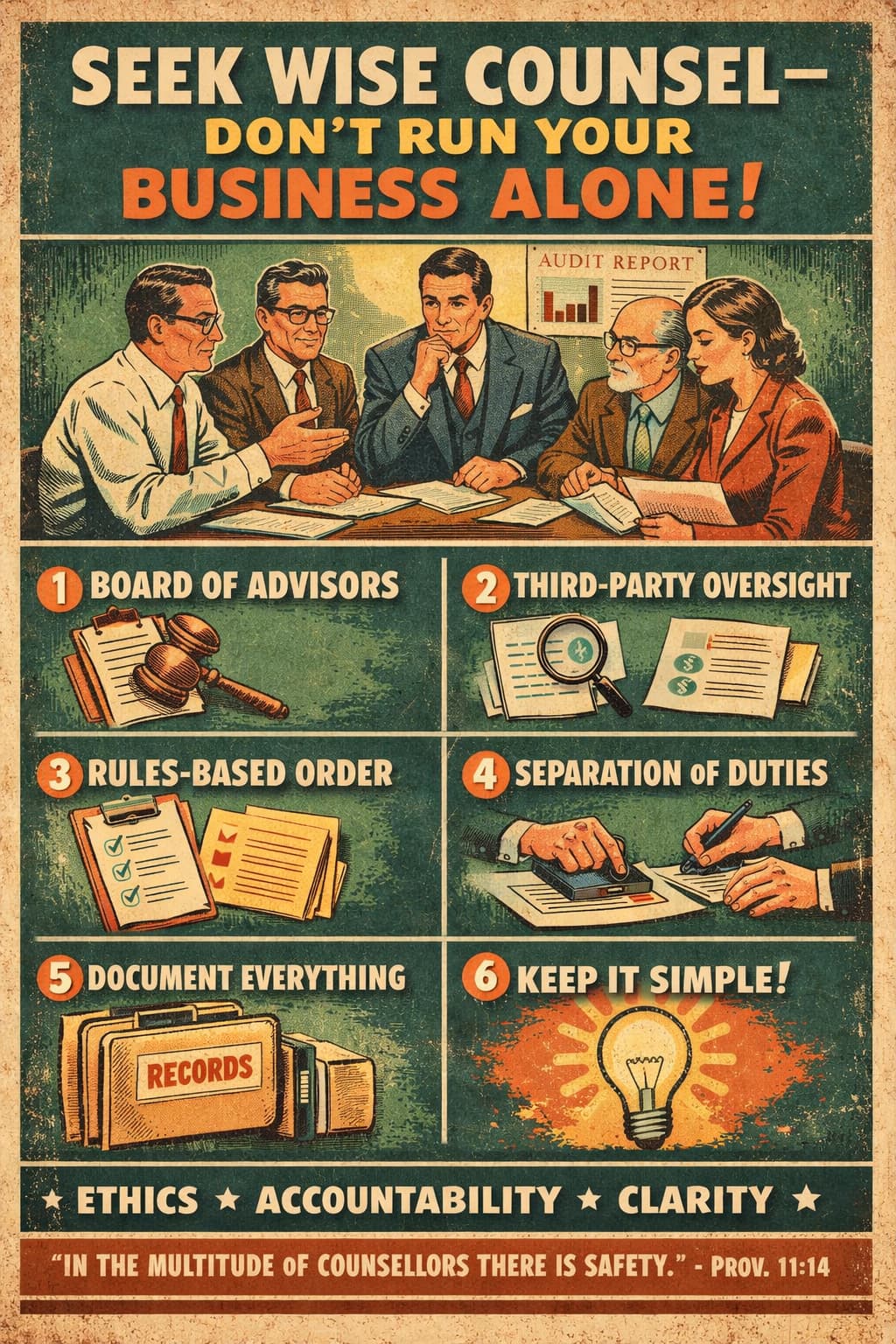
A healthy organization includes six essential elements:
1. A Board of Trusted Governance Advisors
Every organization should maintain a circle of independent, trusted advisors—ideally formal board members—who bring deep operational expertise in areas critical to the organization’s long-term viability and success.
At a minimum, this should include:
- A licensed CPA
- A licensed attorney
- A trusted expert who deeply understands technology and systems
Most importantly, every advisor must understand and adhere to a strict ethical code of conduct. Governance without ethics is risk, not protection.
2. Third-Party Oversight
To properly protect assets, organizations must establish independent third-party oversight, particularly in accounting and IT. Internal teams should never be the sole validators of their own work.
Regular audits and external reviews:
- Verify accuracy and integrity
- Ensure compliance
- Protect core organizational assets
- Build trust with stakeholders
Oversight is not a sign of distrust—it is a sign of maturity.
3. A Healthy Respect for Rules-Based Order
Governance meetings and decision-making processes must operate under clearly defined rules that apply equally to all members. No individual should ever operate outside of those rules.
Strong organizations are built on:
- Consistent governance procedures
- Enforced accountability
- Shared responsibility for integrity
When rules are respected, trust grows. When rules are ignored, organizations fracture.
4. Clear Separation of Authority and Duties
No single individual should control decision-making, execution, and verification in the same area.
Best practice requires:
- Segregation of financial duties
- Defined approval thresholds
- Clear documentation of who can decide, who executes, and who reviews
This protects both the organization and the individuals serving it. Concentrated authority invites risk—even when intentions are good.
5. Formal Documentation and Institutional Memory
Healthy organizations do not rely on oral tradition or “everyone remembers.”
This includes:
- Written bylaws and charters
- Documented votes and meeting minutes
- Retained contracts and policies
- Clear onboarding for new board members
Organizations outlast people. Institutional memory must live on paper, not personalities.
6. Keep the Mission Simple
Complexity is not wisdom. Overcomplicating the mission creates confusion, slows decision-making, and weakens accountability.
Healthy organizations:
- Clearly articulate their mission in plain language
- Avoid unnecessary layers, committees, and processes
- Regularly test decisions against the core mission
Simplicity protects focus. Focus protects impact.